We Make Local Rails Globally Usable. Here Is What That Actually Means.
Most businesses don't decide they need financial orchestration. They get forced into it. AO breaks down what Passpoint's tagline actually means, why local rails are not a limitation but a description, and what changes
MAY 15 - 3 MIN READ

When we say "we make local rails globally usable," people nod. It sounds right. It sounds like something a payments company should be able to do. And then, about thirty seconds later, someone asks me what it actually means.
I love that question. Because the answer is where the real Passpoint story lives.
Let me try to explain it the way I explain it in conversations, without the technical language, without the infrastructure jargon, and without assuming you already know what a payment rail is or why it matters that we can govern forty-two of them through one integration.
Start Here: What a Rail Actually Is
A payment rail is simply the network that moves money from one place to another. M-Pesa is a rail. The Nigerian interbank network is a rail. The ACH system in the United States is a rail. Visa and Mastercard are rails. Open banking in Europe is a rail.
Every market has its own dominant rails, built for the specific financial context of that market. M-Pesa exists because Kenya had high mobile phone penetration and low formal banking access. The NIP interbank network in Nigeria exists because Nigerian consumers and businesses needed a faster, more reliable way to move money between bank accounts. These rails are not inferior versions of global payment infrastructure. They are purpose-built solutions to specific local problems, and in many cases they are genuinely world-class.
The word "local" in our tagline is not a limitation. It is a description. These rails are local because they were built for specific markets, specific currencies, and specific consumer behaviours. They work extraordinarily well in those contexts.
The problem arrives when a business needs to operate across multiple local contexts simultaneously.
The Problem Nobody Warns You About
Imagine you are building a product that serves customers in Nigeria, Kenya, and the UK. You need to accept payments from all three markets, disburse to recipients in all three, manage your treasury across three currencies, and stay compliant with three different regulatory frameworks, all at the same time.
The natural first step is to find a payment provider for each market. One for Nigeria, one for Kenya, one for the UK. Each provider gives you access to the dominant rails in their market. Problem solved, right?
Not quite.
You now have three separate API integrations to maintain, each with its own update cycle and its own failure modes. You have three separate settlement reports to reconcile every week, each in a different format. You have three separate compliance relationships to manage, because what the CBN requires in Nigeria is different from what the FCA requires in the UK, which is different from what the CBK requires in Kenya. You have three separate FX conversions happening at rates determined by three separate providers, with spreads you cannot clearly see or compare.
And when you want to enter a fourth market, you start the whole process again.
This is the point where "local rails" stops feeling like a feature and starts feeling like a constraint. Not because the rails are bad, but because nobody is governing them together. Each rail is doing its job. The problem is that there is no layer above them making them work as a system.
What "Globally Usable" Changes
When we say we make local rails globally usable, we mean we built the layer that was missing.
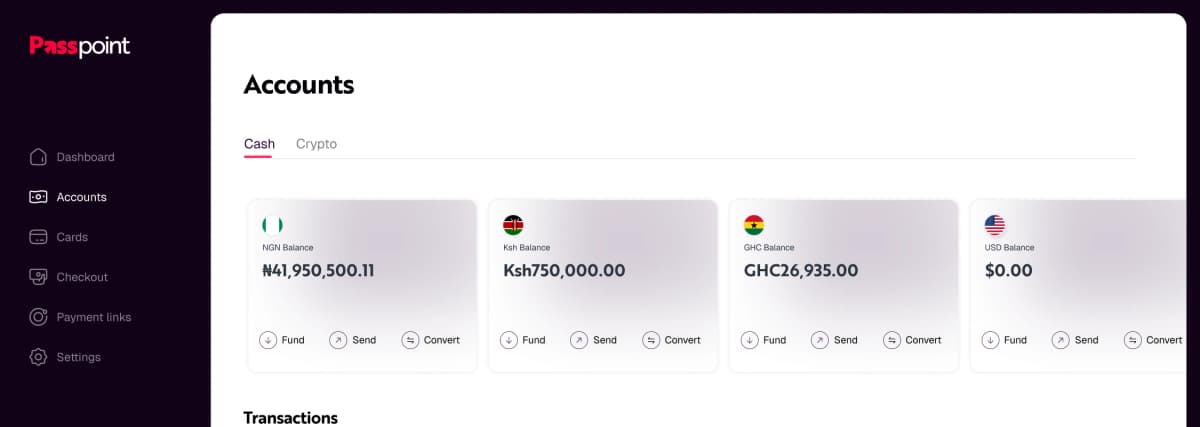
Passpoint sits above the rails, not instead of them, above them. We maintain the relationships with the local payment networks, the mobile money operators, the banks, and the card schemes. We hold the licences that allow us to operate compliantly in each market. And we make all of that accessible to any business through a single integration, a single contract, and a single dashboard.
What that changes in practice is significant.
A business that integrates with Passpoint does not integrate with M-Pesa directly, and then with the Nigerian interbank network directly, and then with open banking in Europe directly. They integrate with Passpoint once, and Passpoint handles all of it. When a transaction arrives, Passpoint decides in real time which rail is the optimal path for that specific transaction, based on current performance data, cost, speed, compliance requirements, and FX efficiency. If the primary path fails, Passpoint routes to the fallback automatically.
The settlement data from every market flows into one report. The compliance logic for every jurisdiction applies automatically at transaction time. The FX conversion happens at institutional rates with full visibility into the spread. And when the business wants to enter a new market, it does not build a new integration. It activates an existing one.
That is what globally usable means. The local rails do not change. The experience of using them does.
Why This Matters More Than It Sounds
I want to be honest about something. When I first started explaining Passpoint this way, I was not sure how much the simplicity of the framing would resonate with the operators and founders I speak to every day. The payments world has a habit of making complexity sound impressive, and I was not certain that "one integration for all of this" would land as credibly as the technical depth deserved.
It lands more than I expected, and the reason is consistent across every conversation. The businesses I speak to are not primarily looking for a better payment product. They are looking for relief. Relief from the operational complexity that has accumulated as they have grown. Relief from the engineering overhead, the reconciliation burden, the compliance management, the FX uncertainty. Relief from the feeling that the payment infrastructure underneath their business is consuming more of their attention and their team's capacity than it should.
When I explain that Passpoint replaces all of that with one integration, one contract, and one operational relationship, the response is almost always the same. It is not excitement. It is recognition. The recognition that this is exactly what they have been looking for, and that they had not been able to articulate it clearly until someone said it plainly.
That recognition is what the tagline is designed to produce. Not to impress, but to clarify.
One More Thing
I want to say something that does not always make it into the infrastructure conversation but that I think matters a great deal.
Behind every payment that flows through Passpoint's orchestration layer is a business trying to serve its customers well. A fintech trying to pay its users reliably. A marketplace trying to make sure its sellers receive what they earned. A remittance operator trying to make sure a family in Lagos receives money from a relative in London quickly and at a fair rate. An enterprise trying to pay its African suppliers without absorbing unnecessary FX costs.
These are not abstract use cases. They are real businesses, run by real people, making real decisions every day about how to allocate their resources and where to direct their energy. The promise we make to those businesses when we say we make local rails globally usable is not a technical promise. It is an operational one.
We are saying: the infrastructure will not be the thing that slows you down. Focus on your customers, your product, and your growth. We have the rails.
That is what the tagline means. And that is what we built Passpoint to deliver.