Local Payments Work. Cross-Border Payments Are Still Broken.
Local payment rails are not the problem. The rails work well inside their own markets. The problem is they were not built to connect to each other. That gap is one of the most important infrastructure challenges.
MAY 18 - 5 MIN READ

Something important happened in payments over the last two decades that rarely gets the credit it deserves.
Countries built rails.
Nigeria built NIP, a real-time interbank settlement network that processes hundreds of millions of transfers annually and has fundamentally changed how Nigerian consumers and businesses move money. Kenya built M-Pesa, a mobile money infrastructure so deeply embedded in daily commerce that it handles everything from market stall payments to salary disbursements for a significant majority of the adult population. Brazil built PIX, an instant payment system that processed over 40 billion transactions in its first two years. India built UPI, which now handles more than 10 billion transactions per month. The UK built Faster Payments. Europe built SEPA. Across francophone West Africa, mobile money operators built a regional payment infrastructure that spans eight countries sharing a common currency.
These are not emerging technologies. They are mature, trusted, deeply adopted payment infrastructure that works, and works well, inside their own markets.
So why is cross-border payment still this difficult?
The Rail Is Not the Problem
When businesses talk about the challenges of cross-border payment across African and global markets, the conversation often gravitates toward infrastructure quality. The assumption is that if local rails were better, the cross-border problem would be solved.
That assumption is wrong, and it leads the industry toward the wrong solutions.
The problem is not rail quality. NIP is a world-class interbank settlement system by any global standard. M-Pesa is more sophisticated and more widely adopted than the mobile payment systems of most mature Western markets. PIX has outperformed expectations in every measurable dimension since its launch. The rails that exist are not the constraint.
The constraint is that these rails were built for domestic use. They were designed to move money efficiently within their own markets, in their own currencies, under their own regulatory frameworks. They were not designed to connect to each other across borders, and they do not do so naturally.
A Nigerian business that wants to pay a Kenyan supplier cannot simply initiate a NIP transfer that flows seamlessly into M-Pesa. A Kenyan operator that wants to collect from a Brazilian customer cannot easily accept PIX payments. A business operating across Nigeria, Kenya, Tanzania, and the XOF region needs a separate integration, a separate provider relationship, a separate settlement process, and a separate compliance framework for each market it enters.
That is not a rails problem. That is a connectivity and governance problem.
What the Disconnection Actually Costs
The cost of disconnected local rails is distributed across the business in ways that make it difficult to see clearly in any single budget line.
Engineering teams spend between 30 and 50 percent of their payment-related capacity maintaining separate integrations per market rather than building product. Finance teams manually reconcile settlement data from multiple provider dashboards in different formats, assembling a cash position that is always slightly behind reality because it is constructed rather than automatic. Compliance teams manage separate regulatory frameworks per market, with no unified view of the business's aggregate compliance posture. Treasury teams carry FX exposure across currencies without the visibility required to manage it actively.
Beyond the operational overhead, disconnected rails create a customer experience problem that shows up directly in conversion rates. A global payment experience that defaults to card checkout reaches only a fraction of African consumers who primarily pay through mobile money, bank transfer, or wallet-based systems. Asking those customers to use a payment method that is unfamiliar or unavailable to them is not a checkout optimisation problem. It is a fundamental infrastructure mismatch between how customers pay locally and how businesses are set up to collect globally.
The commercial cost is real. Checkout abandonment in African markets is significantly higher for businesses that offer only card-based payment options. The customers are there. The payment intent is there. The infrastructure that connects local payment habits to global commerce is not.
The Gap That Needs to Be Closed
If local rails remain disconnected, three things follow: businesses cannot scale efficiently across markets because each new market requires rebuilding the payment stack from scratch, customers are forced into payment methods that are not natural to them because the native payment infrastructure is not accessible to global commerce, and cross-border transactions remain more expensive, slower, and more operationally complex than the quality of the underlying rails would suggest they need to be.
Closing this gap requires a specific kind of infrastructure: not more rails, but a layer above the rails that connects them. A layer that makes it possible for a Nigerian bank transfer, a Kenyan mobile money payment, a European open banking transaction, and a US ACH transfer to flow into the same merchant settlement through one integration, one contract, and one operational relationship.
This is not a theoretical future state. It is the infrastructure challenge that defines the current moment in global payments, and it is the challenge that the most ambitious payment infrastructure companies are building toward right now.
What Connected Rails Enable
When local rails are connected through a governance layer, several things change simultaneously for businesses operating across markets.
Collection becomes local for every customer regardless of where the business is headquartered. A Nigerian customer pays by bank transfer. A Kenyan customer pays by mobile money. A European customer pays through open banking. The business collects in each local context without managing a separate integration for each.
Settlement becomes consolidated across markets and currencies through one reporting layer. The finance team reviews data rather than assembling it.
Compliance becomes embedded in the payment flow rather than managed as a parallel manual process per jurisdiction.
FX becomes a managed position rather than a cost absorbed passively at settlement, with visibility and control over when and how conversions happen.
And market expansion becomes a configuration decision rather than an engineering project, because the infrastructure required to operate in a new corridor is already built into the connected layer.
The Clearest Statement of the Problem
Local payments work. The problem is that local rails are not globally connected.
That is the infrastructure gap that the next phase of global payment development needs to close. Not by replacing the rails that exist, many of which are genuinely excellent, but by building the governance layer above them that makes them usable as a coherent global system.
The future of cross-border payments is not one universal payment method replacing every local one. It is connected local rails, where customers pay the way they already pay, and businesses operate globally on top of the infrastructure that already exists.
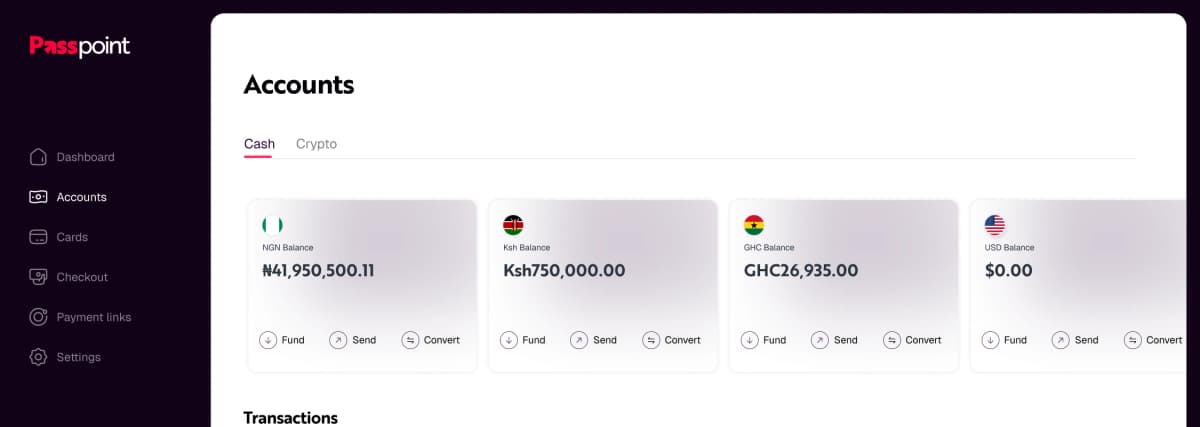
Passpoint is the financial orchestration layer that makes local rails globally usable, connecting 42 corridors across Africa, Europe, and the G20 through a single integration so that the power of local rails becomes accessible to every business operating across markets.