What Passpoint Is and Why the Distinction Matters
Passpoint is not a payment provider. It is the financial orchestration layer for Africa, Europe, and the G20. Here is what that distinction means, what the four layers of the infrastructure do, and who it is built for.
AUG 07 - 5 MIN READ

Most companies in the payments space describe themselves in the same language. Fast. Global. Reliable. Easy to integrate. The language is so consistent across the industry that it has stopped meaning anything specific about any individual company.
Passpoint does not fit neatly into the standard payment company description. Not because the standard description is wrong, but because it is describing a different category of infrastructure entirely.
Understanding what Passpoint actually is requires understanding the distinction between a payment provider and a payment orchestration layer. The distinction is not semantic. It determines what a business can build on top of the infrastructure, how that infrastructure scales as the business grows, and whether the payment stack becomes a competitive advantage or a compounding operational overhead over time.
What Payment Providers Do
A payment provider moves money. It accepts a transaction instruction, routes that instruction through whatever rail it has access to in the relevant market, and settles the resulting funds into the merchant or business's account.
This is genuinely valuable and most businesses need it. The problem is that moving money and governing how money moves are two different things, and at scale across multiple African and global markets, the difference between them becomes the primary operational constraint on growth.
A payment provider operating in Nigeria has NIP access. A payment provider operating in Kenya has M-Pesa relationships. A payment provider claiming African market coverage may have nominal access to a set of corridors through aggregators and correspondent banking relationships that add cost, settlement delay, and data loss between the origination point and the actual local rail.
When a business uses five payment providers to operate across five African markets, it is not operating a payment system. It is managing five separate payment relationships, five settlement processes, five reconciliation workflows, and five compliance frameworks simultaneously, without a unified view of its aggregate financial position across any of them.
That is payment management. It works at small scale. It consumes the business at large scale.
What Passpoint Is
Passpoint is the financial orchestration layer for Africa, Europe, and the G20.
The distinction is architectural. Passpoint does not sit beside a business's payment providers. It sits above them, and above the local rails they access, as the governance layer that controls how money moves across every corridor the business operates in simultaneously.
One integration connects a business to 42 payment corridors across Africa, Europe, and the G20. Every major payment rail in every supported market; NIP in Nigeria, M-Pesa in Kenya, Vodacom and Airtel and Tigo in Tanzania, MTN and Airtel in Uganda, MTN and Orange in Cameroon, Orange Money and MTN MoMo and Wave across the eight-country XOF region, open banking across 24 EU countries and the United Kingdom, ACH and Fedwire and SWIFT and RTP and FedNow in the United States, USDC and USDT on-ramp and off-ramp across African corridors, is accessible through that single integration.
When a new corridor goes live on the Passpoint network, every participant in the network gains access to it. No additional development required, no new contract, no new provider relationship to manage.
This is the network model, and it is fundamentally different from the aggregation model that most payment infrastructure companies operate on.
The Four Layers That Define What Passpoint Does
Passpoint's infrastructure is built around four capabilities that together constitute what it means to govern payments rather than just move them.
The connectivity layer provides direct access to local payment rails across Africa and the G20. Not nominal coverage through correspondent banking chains. Direct integration with the rails themselves, built through years of regulatory relationship development and technical integration work in each market. This depth is what makes the settlement speed, cost, and reliability of local rail infrastructure available to businesses that would otherwise route through correspondent chains because building that direct access themselves is not commercially viable.
The intelligent routing layer makes dynamic decisions at transaction time. Every payment is routed to the optimal available path based on real-time performance data across providers and corridors, current success rates, settlement speed, cost, FX efficiency, and compliance status. When the primary path underperforms or fails, automatic fallback executes before the customer sees a failure. The routing intelligence compounds over time as more transaction data trains the models that make routing decisions.
The compliance layer embeds the regulatory framework of each jurisdiction into the payment flow rather than layering it on top as a separate process. KYC, AML, and sanctions screening are native to the transaction rather than a checkpoint before or after it. As regulations evolve in any supported market, the compliance layer updates automatically. The business does not manage regulatory compliance per market. It manages one integration that carries the compliance framework already built in.
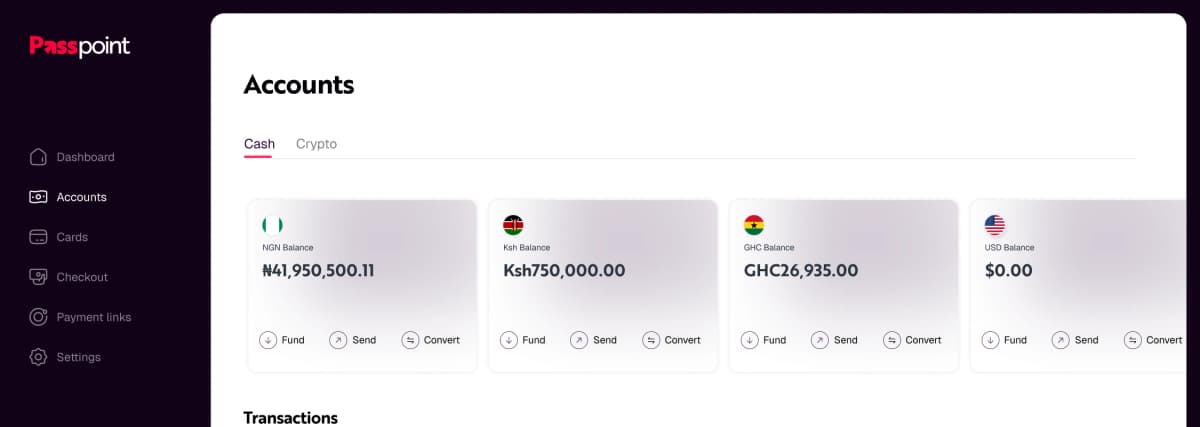
The FX and settlement layer governs currency conversion with institutional rate access, full transparency into the rate applied and the timing of conversion, and active control over when conversions happen rather than passive absorption of whatever rate the settlement chain applies. Settlement data consolidates across all markets and currencies through one unified dashboard. The finance team reviews a single accurate picture of the business's financial position rather than assembling one from multiple provider reports in different formats.
Who Passpoint Is Built For
Passpoint's architecture is designed for the specific needs of five categories of operator.
Banks and financial institutions that want to offer cross-border payment capability across African and G20 markets to their customers without building the rail access, compliance infrastructure, and FX management themselves. Passpoint provides new revenue through FX margin on every cross-border transaction, deeper customer retention through local payment method access in every supported market, and regional expansion across 42 corridors without requiring local entity establishment in each.
Wallets and fintechs that are expanding across African markets and have reached the point where their payment stack is consuming more operational capacity than it should. Passpoint replaces the patchwork of provider relationships assembled market by market with one orchestration layer that scales with the business rather than compounding overhead with every new corridor added.
Enterprises and merchants that collect from customers across African and global markets and pay out to suppliers, sellers, or partners in their local currency. Passpoint provides local payment method access at checkout for every supported market, seller and supplier payouts in local currency through local rails, and unified settlement across every market through one operational layer.
Gaming and iGaming operators for whom deposit success rate and withdrawal speed are directly correlated with player retention. Passpoint provides direct local rail access for deposits and same-day withdrawal capability where local rails support it, with intelligent routing that maximises success rates and automatic fallback that prevents failures from reaching the player.
Digital asset operators and exchanges that want to bridge the gap between digital asset holdings and real-world payment utility. Passpoint's USDC and USDT on-ramp and off-ramp across African corridors allows users to pay with stablecoins at any connected merchant, with the merchant receiving local currency and no off-ramp friction between the digital asset and the local payment rail.
Why the Distinction Matters
The payment infrastructure a business chooses at an early stage compounds in both directions.
Infrastructure that is designed to govern the full payment lifecycle across multiple markets scales with the business. Every new market adds a corridor to the orchestration layer rather than a new provider relationship with its own overhead. The engineering capacity that would have gone toward integration maintenance goes toward product development. The finance capacity that would have gone toward manual reconciliation goes toward financial analysis and planning. The compliance capacity that would have gone toward managing separate frameworks per jurisdiction goes toward the strategic compliance decisions that actually require human judgment.
Infrastructure assembled market by market creates the opposite compounding. Each new market adds overhead that does not scale linearly. By the fifth market the payment stack is consuming a material share of the business's operational capacity without any single decision having looked obviously wrong at the time it was made.
Passpoint is the infrastructure built for the business that has decided to govern its payment operations rather than manage them. One integration. Forty-two corridors. Full control across Africa, Europe, and the G20.
The distinction between a payment provider and a payment orchestration layer is the distinction between infrastructure that scales with your business and infrastructure that creates a ceiling on how far it can go. Read more articles 1. Africa Needs Sovereignty Over Its Own Rails. 2. The G20 Has Been Trying to Fix Cross-Border Payments for Six Years 3. Africa's Cross-Border Payments Need Governance, Not More Management