How to Choose the Right Payment Infrastructure for a Growing African Business
The payment infrastructure beneath your business either creates competitive advantage or quietly erodes it. In Africa, choosing the right architecture has never mattered more.
AUG 24 - 5 MIN READ

Growing a business across African markets is like building a house on multiple plots of land simultaneously. Your payment infrastructure is not just the foundation of one building. It is the connective tissue between all of them. Without the right one, the cracks appear quickly: failed transactions, delayed settlements, manual reconciliation across five different dashboards, and engineering teams rebuilding the payment stack every time the business enters a new market.
For businesses in e-commerce, fintech, gaming, remittance, or any sector operating across African and global markets, the stakes are particularly high. The payment infrastructure underneath your business either compounds your commercial advantage or quietly consumes it. Most businesses do not discover which one it is doing until the cost is already significant.
So how do you choose payment infrastructure that scales with your business rather than against it?
Why Payment Infrastructure Matters More in African Markets
Every transaction your business makes, whether collecting from a customer in Lagos, paying a supplier in Nairobi, or settling with a partner in Accra, passes through some layer of infrastructure. That infrastructure is invisible until it fails. And in African markets, the gap between what infrastructure claims to support and what it consistently delivers is wider than in almost any other market in the world.
When payment infrastructure fails an African business, the consequences are specific. Settlement arrives three to five days late because the payment routed through a USD correspondent chain rather than a local rail. FX conversion happens at a spread the business cannot see and cannot negotiate. Engineering teams spend their sprint maintaining provider integrations rather than building product. Finance teams manually reconcile settlement data from four different providers in different formats.
These are not edge cases. They are the operational reality of the majority of African businesses that assembled their payment infrastructure market by market rather than choosing a layer designed to govern the full operation.
What African Businesses Actually Need From Payment Infrastructure
The requirements of a business expanding across African markets are more specific than the generic list most payment infrastructure articles produce.
Speed that reflects local rails, not correspondent chains. NIP in Nigeria settles in seconds. M-Pesa in Kenya settles in seconds. The infrastructure your business connects to should deliver settlement at the speed of those rails, not at the speed of the correspondent banking chain that sits between your provider and them.
Reliability with intelligent fallback. A failed transaction in an African market is not just a lost sale. It is a lost customer relationship in a market where payment trust is hard-earned. Infrastructure that routes to the optimal path per transaction and fails over automatically when that path degrades is not a premium feature. It is the baseline requirement for operating at scale.
Compliance that is embedded, not managed. Every African market has its own regulatory framework. CBN in Nigeria. CBK in Kenya. BCEAO across the XOF region. Managing compliance separately per market, manually, at the speed your business needs to move is not viable at scale. Infrastructure that embeds compliance logic per jurisdiction automatically, and updates it as regulations evolve, is what makes market expansion operationally tractable.
FX transparency and control. The spread between the rate your provider applies at settlement and the mid-market rate on any given day is often the largest single hidden cost in cross-border payment operations for African businesses. Infrastructure that gives you visibility into conversion rates, competitive institutional pricing, and timing control over when conversions happen is not just operationally better. It is commercially significant.
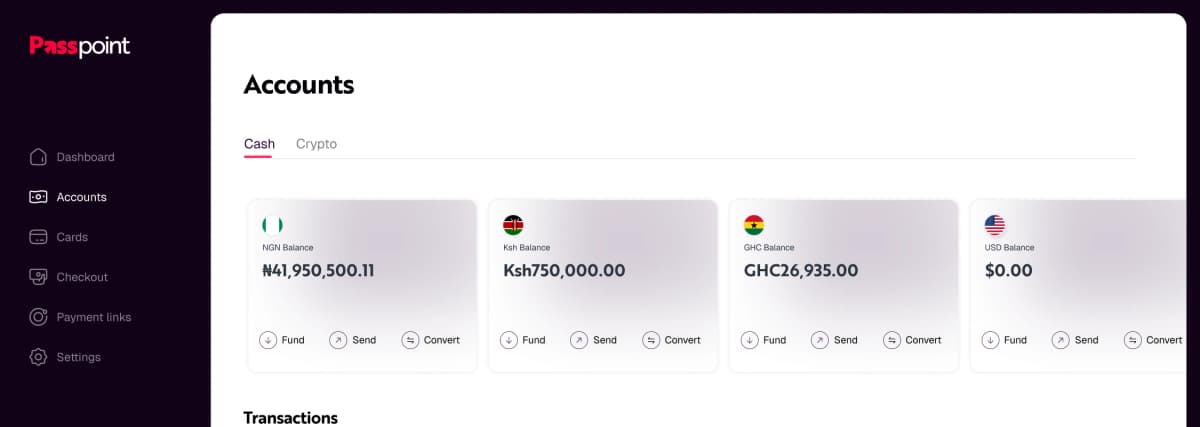
A single operational view across all markets. Finance teams that reconcile settlement data from multiple providers in different formats, on different timelines, in different currencies, are spending capacity that should go toward financial analysis and planning. Infrastructure that consolidates settlement, reconciliation, and reporting across every market through one dashboard eliminates that overhead.
The Problem With Traditional Approaches
Most African businesses build their payment infrastructure the same way: one provider per market, chosen because it was the most visible option when the business entered that market, assembled into a stack that was never designed to be coherent.
This approach has a specific failure mode. It works adequately at the single-market stage. It compounds into structural drag at the multi-market stage. Every new market adds a new integration, a new reconciliation workflow, a new compliance framework, and a new provider relationship to manage. The engineering overhead does not scale linearly. It multiplies. And by the time the business is operating across five markets, the payment stack is consuming a material share of its operational capacity without any of the participants having made a single decision that looked obviously wrong at the time.
The alternative is not finding better providers for each market. It is choosing a different architecture entirely: a single orchestration layer that governs payment operations across every market the business operates in, rather than a set of bilateral provider relationships assembled market by market.
What the Right Architecture Looks Like
The payment infrastructure that African businesses scale on efficiently shares a specific set of characteristics.
It sits above the rails rather than being a rail itself. This distinction matters because it means that when a new payment method becomes relevant in a market the business already operates in, or when the business enters a new market, the infrastructure adds that capability without requiring a new integration from the business side.
It governs the full payment lifecycle, not just the acceptance event. Collection, routing, settlement, reconciliation, FX management, compliance, and payouts are all governed through the same layer. The business does not manage them separately per market or per provider.
It provides direct access to local rails rather than nominal coverage through aggregators. The difference between infrastructure that claims African market coverage through a correspondent chain and infrastructure that is directly integrated with NIP, M-Pesa, XOF mobile money operators, and the equivalent rails in each market is the difference between three-day settlement and same-day settlement, between opaque FX spreads and institutional rates, and between nominal reach and genuine operational depth.
It has the regulatory credibility to operate across multiple African jurisdictions simultaneously. Licences from the relevant central banks and regulatory authorities in each market are not a feature. They are the foundation that makes everything else trustworthy at the institutional level.
The Infrastructure African Businesses Deserve
Passpoint is the financial orchestration layer built for businesses that are done assembling payment infrastructure market by market and are ready for a single layer that governs all of it.
One integration connects your business to 42 corridors across Africa, Europe, and the G20. NIP in Nigeria. M-Pesa in Kenya. Mobile money across East and West Africa. Open banking across 24 EU countries and the UK. The full USD rail stack in the United States. USDC and USDT on-ramp and off-ramp across African corridors. Intelligent routing. Embedded compliance. Institutional FX. Unified settlement and reconciliation across every market through one dashboard.
Choosing the right payment infrastructure is not just about moving money. It is about choosing whether your payment stack compounds your commercial advantage or quietly consumes it as you scale.
The businesses that choose the orchestration layer early are the ones that enter their fifth market with the same operational efficiency they had in their first. Read more articles 1. Africa Needs Sovereignty Over Its Own Rails. 2. The G20 Has Been Trying to Fix Cross-Border Payments for Six Years 3. Africa's Cross-Border Payments Need Governance, Not More Management